
A police raid at 101 Poker Club in Katy, Texas, has placed the Houston-area poker scene under renewed scrutiny after authorities seized more than $118,000 and arrested four individuals in connection with an alleged illegal gambling operation.
The Houston Police Department conducted the operation on Thursday, October 22, 2026, at the popular card room along Katy Freeway. What began as a normal day at the poker tables turned into a law enforcement investigation, with officers entering the establishment and interrupting games.
Two days later, Houston police confirmed that their Vice Division, working alongside the Harris County District Attorney's Office, had recovered a substantial amount of money and arrested four suspects on charges of engaging in organized criminal activity. Authorities also indicated that charges were pending against a fifth individual.
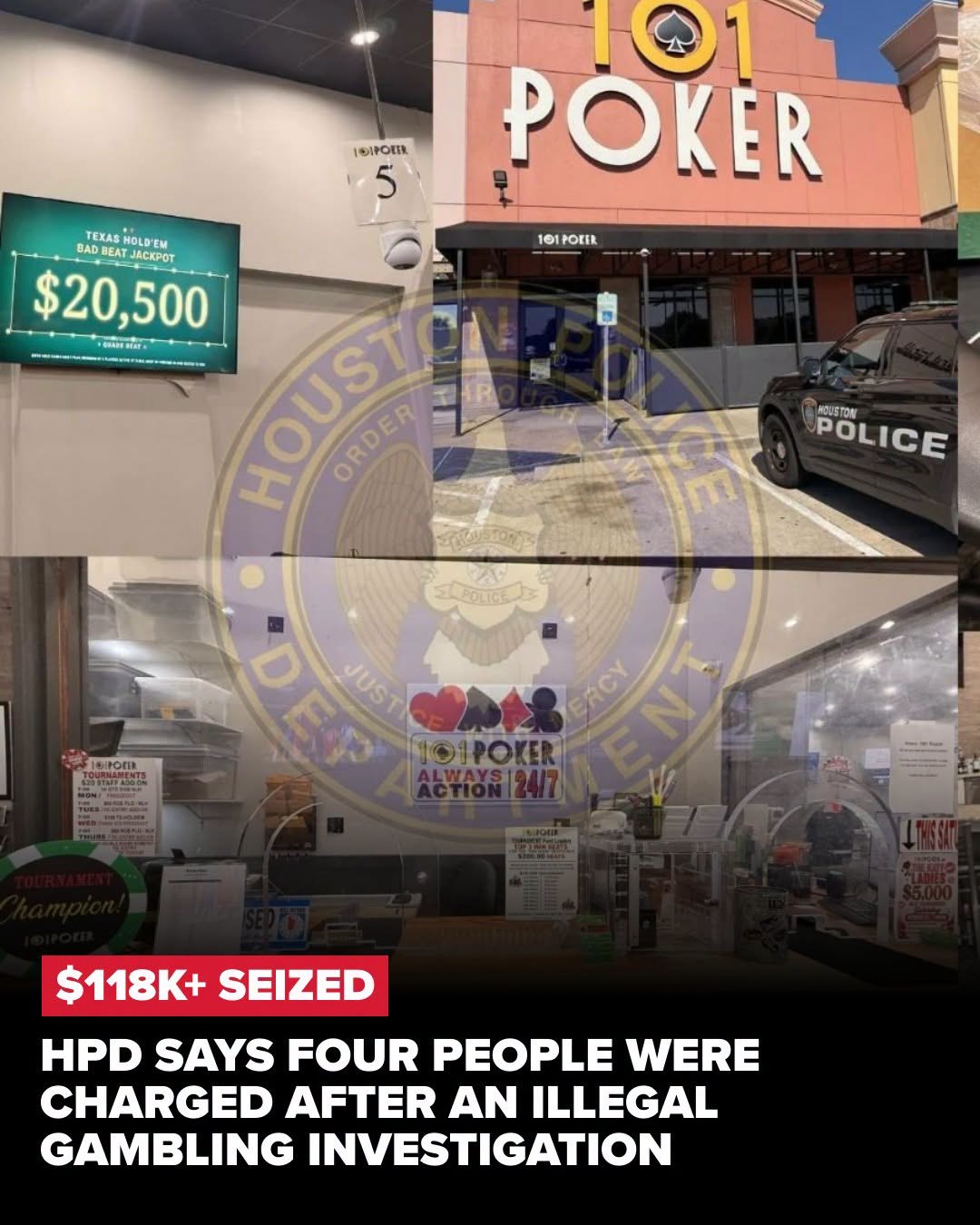
Despite the arrests and seizure, 101 Poker Club announced plans to reopen the following afternoon, creating an unusual situation in which the business appeared ready to resume poker operations while the criminal investigation remained unresolved.
The incident has attracted attention beyond Katy, raising questions about the legality of private poker clubs, the enforcement of Texas gambling laws, and the future of commercial poker rooms operating throughout the Houston metropolitan area.
Houston Police Operation Interrupts Poker Games at Katy Card Room
The October 22 raid took place at 101 Poker Club, located at 20900 Katy Freeway, Suite N-1, in Katy, just west of Houston.
The establishment is part of a growing private poker club industry that has developed across Texas despite the state's restrictive gambling legislation. Unlike traditional casinos, these businesses generally present themselves as membership-based establishments where customers can participate in live poker games.
Thursday's police operation interrupted that environment.
Officers arrived at the premises and took control of the location as the investigation unfolded. Accounts of the incident indicated that customers were directed away from the games while employees remained at the scene for questioning.
The presence of law enforcement immediately raised concerns about whether the establishment had become the subject of a broader investigation into its business practices.
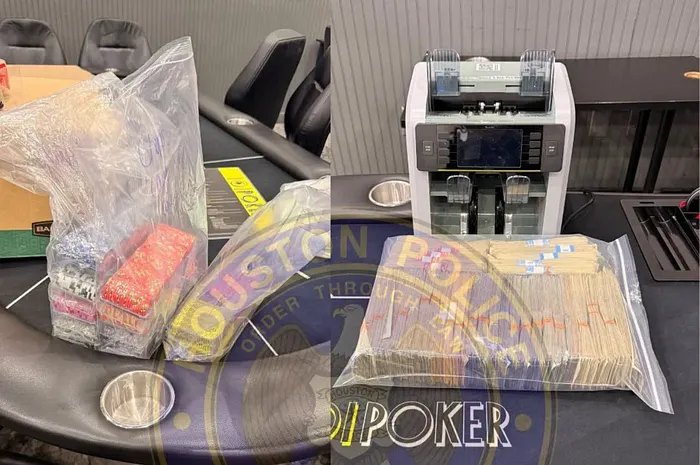
Photographs released in connection with the operation showed poker equipment, chips, cash and items associated with the management of a commercial card room.
The images provided a glimpse of the scale of the investigation but did not independently establish which activities authorities considered unlawful.
Houston police subsequently identified the location as an alleged illegal gambling operation in the 20900 block of Katy Freeway.
The involvement of the department's Vice Division was particularly significant. That unit handles investigations involving suspected gambling violations and other activities regulated under Texas criminal law.
The Harris County District Attorney's Office also participated in the operation, suggesting that the investigation had progressed beyond an ordinary regulatory inspection.
However, the full circumstances leading investigators to the club have not been publicly disclosed.
Authorities have not detailed whether the operation followed undercover surveillance, complaints, financial investigations or another form of evidence gathering.
Those unanswered questions are important because the existence of a police raid does not establish that every activity occurring inside a business was illegal.
For the Houston poker community, the immediate result was nevertheless significant: an established card room had become the focus of criminal allegations, and the authorities were prepared to pursue charges against individuals associated with the investigation.
Four Arrested as Police Confirm More Than $118,000 Seized
The most substantial development emerged on Saturday, October 24, when the Houston Police Department publicly confirmed the financial seizure and arrests.
According to the department, more than $118,000 was recovered during the investigation, while four people were arrested and charged with engaging in organized criminal activity.
Police also stated that charges were pending against another suspect.
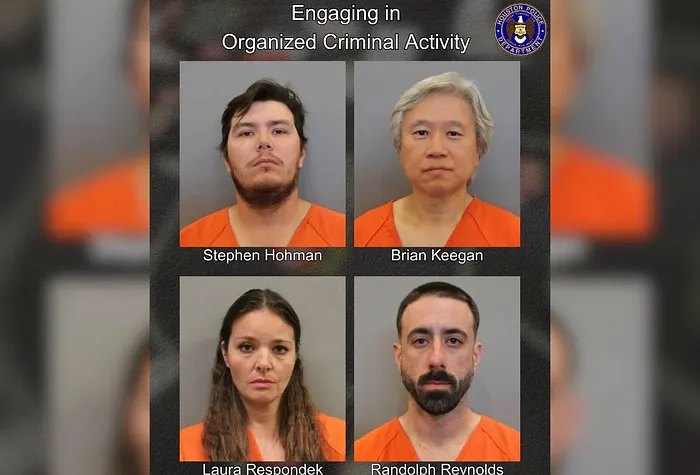
The announcement raised the stakes considerably because organized criminal activity is a more serious allegation than simply participating in a poker game.
Under Section 71.02 of the Texas Penal Code, organized criminal activity can involve participating in or conspiring with a criminal combination to commit qualifying offenses. Certain gambling-related offenses are included within that statutory framework.
However, the specific underlying offense alleged in the 101 Poker Club investigation has not been fully explained in the public information released so far.
That distinction matters.
A charge of engaging in organized criminal activity does not necessarily mean authorities are alleging an international criminal organization, sophisticated money laundering operation or other conduct commonly associated with organized crime.
The statute covers a range of qualifying offenses, and the exact accusations depend on the evidence and charging documents.
Similarly, the discovery of a large amount of cash inside a poker establishment does not automatically prove that the money was obtained unlawfully.
Poker rooms routinely handle cash associated with buy-ins, chip exchanges, player balances and other transactions. Investigators would need to establish how the seized money relates to the alleged criminal conduct.
The $118,000 figure is nevertheless significant, particularly for a local card room rather than a large commercial casino.
The seizure could introduce additional financial questions involving business records, customer funds, accounting practices and the handling of money associated with poker games.
It also creates uncertainty about whether any portion of the confiscated funds could eventually be returned, depending on the outcome of the investigation and applicable legal procedures.
For now, the most important legal fact is that four individuals have been charged, while the potential case against a fifth person remains unresolved.
Criminal charges are allegations, not convictions, and the individuals involved are entitled to the presumption of innocence.
101 Poker Club Announces Reopening Following the Raid
One of the most unexpected developments came shortly after the police operation.
Rather than announcing an indefinite shutdown, 101 Poker Club published a reopening notice on its public room listing, stating that it planned to resume business at 1 p.m. on Friday, October 23.
That was less than 24 hours after the raid.
The announcement suggested that the enforcement action had not resulted in an immediate permanent closure of the establishment.
The club's published information also continued to advertise upcoming poker tournaments, promotions and cash-game opportunities, indicating an intention to maintain its regular schedule.
The Katy venue lists 11 poker tables and offers No-Limit Hold'em cash games, including $1/$3 and $5/$5 stakes. Its promotional calendar has also featured Pot-Limit Omaha activities and scheduled tournaments.
These details underline the club's role as an established poker destination rather than an occasional private game.
Its business depends on attracting regular customers, maintaining game availability and giving players sufficient confidence to bring money to the tables.
The decision to reopen so quickly may help preserve those relationships, but it also creates challenges.
Players could reasonably have concerns about future interruptions, the security of funds held at the property and whether additional enforcement action could follow.
Employees and management face a separate set of uncertainties involving the continuing investigation and any potential changes to operating procedures.
The reopening announcement should not be interpreted as confirmation that authorities have approved the club's business model or that the investigation has ended.
A business can resume operations while criminal proceedings continue, and a police investigation does not automatically create a permanent legal prohibition on trading.
Equally, the ability to reopen does not establish that investigators' allegations are correct.
For 101 Poker Club, the immediate question is whether it can continue operating while navigating the financial, legal and reputational consequences of the October 22 raid.
Texas Poker Laws Put Private Card Rooms Under Legal Scrutiny
The police raid at 101 Poker Club has brought renewed attention to one of the most complicated issues surrounding poker in Texas: the distinction between private gambling and commercially operated card rooms.
Texas does not have the same regulated commercial poker industry found in states such as Nevada.
Instead, private poker businesses have developed models designed around exemptions and defenses contained in existing state gambling laws.
Section 47.02 of the Texas Penal Code generally prohibits betting money or other items of value on card games. However, it provides a defense to prosecution when certain requirements are satisfied.
Those conditions include gambling taking place in a private location, nobody receiving an economic benefit beyond personal winnings, and participants having equal risks of losing and chances of winning apart from the effects of skill or luck.
Section 47.04, which addresses keeping a gambling place, contains a related affirmative defense.
For poker club operators, these provisions have become central to how their businesses are structured.
Many Texas poker rooms charge customers membership fees, hourly seat charges or other access fees instead of collecting a percentage of each pot.
In conventional casino poker, the house usually earns revenue through a rake, meaning that a portion of the money wagered in a hand is removed for the operator.
Membership-based poker clubs attempt to separate their income from the outcome of individual hands by charging for access to the facility and its services.
However, this distinction is not an automatic guarantee of legality.
The relevant legal questions extend beyond whether a business calls itself a private club or collects a traditional rake.
Investigators and courts may also consider how membership works in practice, who can enter the premises, whether the establishment genuinely functions as a private place and how the operator receives financial benefits.
The interpretation of these requirements has generated disagreements between poker club operators, local authorities and legal professionals for years.
In the case of 101 Poker Club, authorities have not publicly established whether the investigation concerns rake collection, membership procedures, another gambling-related offense or a combination of alleged activities.
Consequently, it would be premature to identify a particular business practice as the confirmed reason for the raid.
The wider issue is that Texas poker clubs operate in an environment where a business can be open to the public for extended periods while still facing questions over its interpretation of gambling law.
That uncertainty affects both operators and customers.
For businesses, it complicates decisions about investment, expansion, staffing and financial management.
For players, it makes it harder to determine whether an established poker room might face unexpected enforcement action.
The raid in Katy demonstrates that the legal debate surrounding Texas poker is far from settled.
Houston Poker Enforcement Has a Complicated History
The investigation involving 101 Poker Club is not the first occasion on which Houston-area authorities have targeted businesses offering poker and other gambling activities.
In May 2026, Houston police raided Lucky J Social Club on Richmond Avenue during an investigation into suspected illegal gambling.
The operation involved a police SWAT team, and authorities reported that approximately 80 to 90 people were inside the establishment.
Three men were subsequently charged with misdemeanor gambling-promotion offenses, while police seized more than $350,000 in cash and gambling equipment.
Although that investigation involved a different venue and different allegations, it demonstrated the willingness of Houston authorities to conduct substantial enforcement operations against private gambling establishments.
Earlier cases also show that the outcome of a raid is not always straightforward.
In May 2019, authorities conducted high-profile raids at two Houston establishments, Prime Social Poker Club and Post Oak Poker Club.
Nine individuals associated with those businesses faced criminal allegations, including money laundering and organized criminal activity.
The prosecutions subsequently collapsed after the Harris County District Attorney's Office identified potential conflicts of interest involving a former consultant and political fundraiser.
The charges were dismissed, and the matter was referred to federal authorities for review.
Related civil actions seeking to close the businesses were also dropped.
Those events remain relevant because they demonstrate the difference between an enforcement operation and a successful criminal prosecution.
A police raid can produce arrests, substantial financial seizures and intense publicity without necessarily resulting in convictions.
Elsewhere in Texas, disputes over poker club operations have also reached the courts.
In September 2025, the Texas Supreme Court declined to review an appeal involving Texas Card House in Dallas, leaving a lower-court outcome that allowed the establishment to remain open.
That dispute concerned the city's attempts to revoke the poker business's occupancy permission and reflected broader disagreements about the treatment of private poker facilities.
The Dallas ruling did not establish unrestricted statewide legality for commercial poker clubs. Nevertheless, it illustrated how individual disputes can turn on administrative decisions, specific legal arguments and the circumstances of a particular establishment.
The history of these cases makes the future of 101 Poker Club difficult to predict.
Some enforcement actions have been followed by business reopenings, while others have produced substantial legal and financial disruption.
The outcome depends on evidence, applicable statutes, prosecutorial decisions and the arguments presented by the people facing allegations.
It would therefore be misleading to assume that the Katy investigation will necessarily follow the same course as an earlier Houston poker raid.
What Happens Next for 101 Poker Club and Houston's Poker Community?
As of October 26, 2026, the investigation surrounding 101 Poker Club remains an important developing story for the Texas poker industry.
Houston police have confirmed the arrests and cash seizure, but significant aspects of the allegations remain publicly unexplained.
The next major developments could come through additional statements from investigators, formal charging documents, court proceedings or responses from the individuals accused.
Those records may establish which specific gambling offenses prosecutors believe occurred and how the alleged conduct connects to the organized criminal activity charges.
They could also clarify the legal status of the seized money and whether investigators intend to pursue further action against the establishment.
For the club itself, the challenge is likely to extend beyond the immediate criminal proceedings.
A poker room's reputation is closely connected to player trust. Customers need confidence that games will continue, funds will be handled properly and the venue can operate without repeated interruptions.
Even when a business remains open, uncertainty surrounding an investigation can influence attendance and customer behavior.
Other poker club operators in Houston may also follow the Katy case closely.
Although the circumstances of every establishment differ, the investigation highlights the importance of understanding how Texas authorities interpret the rules governing private poker operations.
Operators may revisit membership procedures, recordkeeping, revenue structures and legal compliance in response to the renewed attention.
There is also a broader question about the long-term future of live poker in Texas.
Private poker clubs have created a market for players who want organized games without travelling to casinos in other states. That demand has encouraged businesses to invest in professional tables, tournament schedules, dealers and dedicated gaming facilities.
Yet the absence of a comprehensive, clearly settled statewide regulatory framework continues to create uncertainty.
The 101 Poker Club raid will not resolve that larger issue on its own.
Its immediate significance lies in the combination of substantial financial seizures, organized criminal activity charges and the club's rapid reopening announcement.
The coming legal proceedings will determine whether prosecutors can establish the alleged violations and what consequences, if any, follow for those involved.
Until then, the case stands as another reminder that the expansion of private poker in Texas has developed alongside continuing disputes over the law.
For 101 Poker Club in Katy, the tables may have reopened, but the most consequential decisions are now likely to take place away from the poker room.
And for Houston's wider poker community, the outcome could provide an important indication of how aggressively authorities intend to enforce Texas gambling laws against private card rooms in the months ahead.
If you are also interested on how Las Vegas casino are stepping up to increase the security you can read about it here..